Bringing the Mushroom House 3D Shadow Box Paper Cut to Life: A Maker's Guide to Workflow and Execution
Hello, crafters. In the realm of digital fabrication and handmade decor, few projects balance whimsy and technical precision quite like the Mushroom House 3D Shadow Box Paper Cut. This charming piece of art transforms a flat digital file into a miniature world tucked away within the heart of a magical forest. However, for professionals, small business owners, and serious hobbyists, the value of this asset extends beyond its aesthetic appeal. It represents a streamlined workflow where digital planning meets tangible execution. Whether you are an educator creating classroom displays, a marketer designing unique brand experiences, or an entrepreneur building a product line of celestial-themed decor, understanding how to integrate this template into your broader creative process is essential for efficiency and quality.
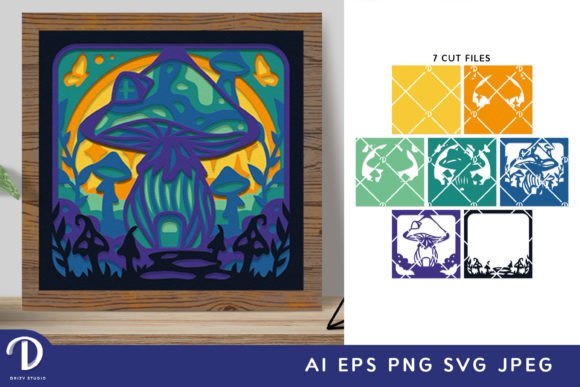
The Mushroom House 3D Paper Cut - Celestial Shadow Box is not merely a picture; it is a layered architectural model made of paper. Crafted with meticulous attention to detail, it requires a systematic approach to move from a downloaded file to a finished installation. By treating the creation of this shadow box as a structured project rather than a casual pastime, you ensure consistency, reduce material waste, and achieve a professional finish that stands up to close inspection.
Asset Acquisition and Technical Preparation
The foundation of any successful paper crafting project lies in the quality and compatibility of the source files. When you acquire the Mushroom House template, you are receiving a comprehensive suite of formats designed to fit various stages of the production workflow. The package typically includes AI, EPS, PNG, SVG, and JPEG files, all optimized at 714 x 714 pixels for vector work, with high-resolution previews at 3000 x 2000 pixels.
For those utilizing automated cutting machines like Silhouette or Cricut, the included SVG file is the critical asset. This format ensures that the intricate details of the mushroom caps, forest foliage, and celestial elements remain crisp regardless of scaling. However, practical implementation demands that you respect the aspect ratio when resizing. Distorting the image can misalign the layers, causing the 3D effect to collapse during assembly. If you do not have access to a digital cutter, the high-resolution raster files allow for precise manual tracing, though this shifts the time investment from machine setup to hand-cutting labor.
Before making the first cut, a thorough review of the seven distinct layers is necessary. This stage acts as your quality control checkpoint. Verify that all bridge points—the tiny connections holding inner details like window panes or leaf veins—are intact. In a professional setting, this prevents mid-project failures where a layer tears or loses structural integrity. Organizing these layers digitally before sending them to the cutter saves significant time during the physical assembly phase.
Material Selection and Compatibility
The success of a 3D shadow box relies heavily on the interaction between the design and the substrate. While the template provides the geometry, the choice of paper determines the depth, shadow intensity, and durability of the final piece. For a standard wall decoration, 65 lb to 80 lb cardstock offers an ideal balance between rigidity and ease of cutting. Heavier stocks may require multiple passes on a cutting machine or sharper blades for manual work, while lighter papers might buckle under the weight of adhesives or fail to cast the deep shadows required for the "celestial" effect.
Color theory plays a subtle but vital role here. The Mushroom House design often utilizes gradients of greens, browns, and night-sky blues. When sourcing materials, consider using textured papers or those with a slight sheen to interact with light differently. If you plan to convert this project into a lightbox by adding LED strips, translucent vellum or specialty lighting paper for specific layers can diffuse the glow, creating an ethereal atmosphere that solid cardstock cannot achieve. This decision must be made during the planning phase, as it dictates the spacing between layers and the type of adhesive used.
The Assembly Process: Precision and Patience
Once the components are cut, the project moves into the assembly phase. This is where the two-dimensional inputs become a three-dimensional reality. The process requires a clean, organized workspace and the right tools: fine-tip tweezers, a bone folder for creasing, and a reliable adhesive system. While glue sticks are common, double-sided tape or foam mounting squares are often superior for shadow boxes. They provide consistent thickness between layers, which is crucial for maintaining the intended depth and preventing the layers from sagging over time.
Assembly should follow a logical sequence, typically working from the background layer forward. Aligning the registration marks or corners perfectly at each step ensures that the mushroom house sits centrally within the forest frame. Rushing this stage often leads to skewed perspectives, breaking the immersion of the miniature world. For entrepreneurs producing these in batches, creating a jig or template to hold the base layer steady can dramatically increase throughput and ensure every unit meets the same quality standards.
During this phase, attention to detail regarding the "Celestial" elements is paramount. If the design includes stars or moons that are meant to float above the forest canopy, ensure the spacing reflects this distance. The interplay of light and shadow is the core mechanism of this art form; incorrect spacing can flatten the image, negating the 3D effect. Use a dry-fit method—assembling the layers temporarily without adhesive—to visualize the depth and make adjustments before committing to permanent bonding.
Integration into Broader Workflows and Use Cases
The utility of the Mushroom House 3D Shadow Box extends far beyond a single weekend project. For educators, this template serves as an excellent tool for teaching spatial reasoning, layering concepts in art, or even biology lessons regarding fungal ecosystems. The process of assembling the seven layers mirrors complex system thinking, making it a valuable hands-on activity for students learning about structure and function.
For marketers and content creators, these shadow boxes offer unique visual assets. A time-lapse video of the assembly process, from flat SVG to finished 3D art, performs exceptionally well on social media platforms. The tactile nature of the project engages audiences looking for authentic, behind-the-scenes content. Furthermore, the finished product can serve as a distinctive backdrop for product photography, adding depth and narrative to brand imagery without the clutter of physical props.
In the context of interior design and home staging, the Mushroom House functions as a versatile decorative element. As a framed wall decoration, it adds texture and whimsy to nurseries, reading nooks, or creative offices. When converted into a lightbox, it becomes a functional nightlight or ambient mood lighting, demonstrating the adaptability of the design. Small business owners can leverage this flexibility to offer customizable options—selling the kit as a DIY experience or the assembled piece as ready-to-hang art.
Long-Term Maintenance and Scalability
To ensure the longevity of your Mushroom House creation, consider the environment in which it will reside. Direct sunlight can fade paper colors over time, so positioning the piece away from intense UV exposure is advisable for preservation. If dust accumulation becomes an issue, a gentle blast of compressed air is safer than wiping, which could dislodge delicate paper bridges.
For those looking to scale this into a business venture, the digital nature of the SVG files allows for easy iteration. You can experiment with different color palettes, paper textures, or even modify the vector paths to create seasonal variations—perhaps adding snow for a winter edition or flowers for spring. The modular nature of the seven-layer design supports this kind of rapid prototyping. By mastering the workflow for the original Mushroom House, you build a repeatable framework for launching new designs, minimizing the learning curve for future projects.
Ultimately, the Mushroom House 3D Paper Cut Shadow Box is a testament to what happens when digital precision meets analog craftsmanship. It fits seamlessly into workflows that value planning, execution, and aesthetic quality. Whether you are cutting a single piece for personal enjoyment or managing a production run for a client, the principles of preparation, material compatibility, and methodical assembly remain constant. By approaching this project with a process-oriented mindset, you transform a simple paper template into a lasting piece of enchanting art.