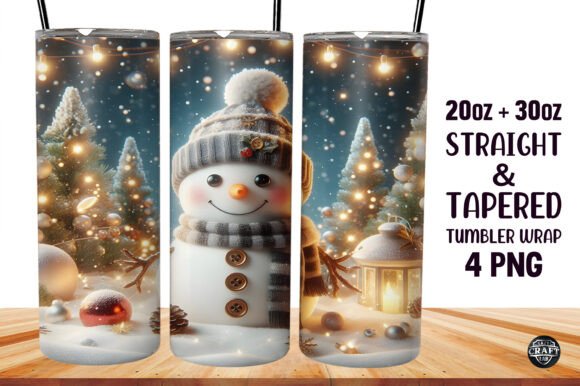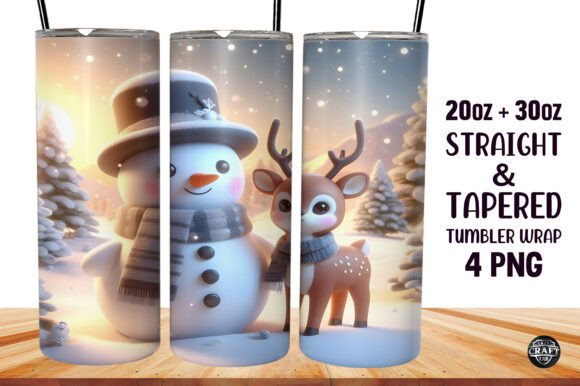
Integrating 3D Snowman and Deer Tumbler Christmas 20 Designs into Your Holiday Production Workflow
The holiday season represents a critical window for creators, small business owners, and hobbyists engaged in the sublimation industry. Success during this period relies less on spontaneous inspiration and more on rigorous preparation, asset management, and streamlined execution. Incorporating specific assets like the 3D Snowman and Deer Tumbler Christmas 20 design into your production pipeline is not merely about selecting an image; it is about optimizing a workflow that balances speed with high-quality output. This guide explores how to effectively integrate these digital assets into your broader creative and business processes, ensuring consistency from file download to final product delivery.
Strategic Asset Acquisition and File Management
The foundation of any efficient sublimation project begins before the printer even warms up. It starts with the acquisition and organization of digital files. When you purchase a package such as the 3D Snowman and Deer Tumbler Christmas 20oz wrap, you are acquiring a set of tools designed to reduce pre-production time. The immediate value lies in the "Instant Download" nature of the transaction, which eliminates shipping delays and allows for immediate integration into your design software.
Upon downloading the zipped folder, the first step in your workflow should be systematic organization. A professional approach involves creating a dedicated directory structure for the holiday season. Within this, separate folders for "20oz Straight," "20oz Tapered," "30oz Straight," and "30oz Tapered" ensure that you never grab the wrong file during a high-volume production run. The included files are typically high-resolution PNGs at 300 DPI with transparent backgrounds. This specification is crucial; it ensures that when you place the 3D Snowman and Deer graphic onto your canvas, there are no unwanted white boxes or pixelation issues that would require time-consuming manual cleanup.
Understanding the dimensions provided is also vital for planning. For instance, knowing that the 20oz Skinny Tumbler designs are sized at 9.3″ x 8.2″ inches allows you to pre-set your document templates in software like Adobe Illustrator, Photoshop, or Canva. By having templates ready that match these exact specifications, you reduce the cognitive load during the design phase, allowing you to focus on color profiling and print settings rather than resizing and aligning assets repeatedly.
Compatibility and Technical Preparation
Before moving to the printing stage, verifying compatibility between your digital assets and your physical hardware is essential. The distinction between straight and tapered tumbler wraps is a common pitfall in sublimation workflows. A design intended for a straight wall will distort if applied to a tapered surface without adjustment. The inclusion of separate PNGs for both straight and tapered tumblers in the 3D Snowman and Deer Tumbler Christmas 20 package addresses this variable proactively.
To maintain quality control, your workflow should include a "pre-flight" check. This involves opening the PNG files in your editing software to confirm transparency and resolution. Since these files are printable PNG downloads and not editable SVGs, your process must respect these limitations. You cannot manipulate individual vector nodes of the snowman or deer. Therefore, your role shifts from "designer" to "integrator." Your task is to position the asset correctly within your template, perhaps adding personalized text or monograms around the fixed graphic, rather than altering the graphic itself.
Color management is another critical intersection where digital files meet physical results. The vibrant colors of a 3D-style design rely heavily on your ICC profiles. Because the source file is high-quality (300 DPI), any color shifting or dullness in the final product can usually be traced back to printer settings or heat press variables, not the file itself. Ensuring your printer is calibrated and your sublimation paper is compatible with your ink set allows the intricate details of the snowman and deer to translate accurately onto the polymer-coated surface of the tumbler.
Execution: From Print to Press
Once the files are prepared and the templates are set, the execution phase begins. This is where efficiency determines profitability. For a small business owner or freelancer managing multiple orders, the ability to batch process is key. You might arrange multiple instances of the 3D Snowman and Deer Tumbler Christmas 20oz wrap on a single sheet of sublimation paper to minimize waste and maximize printer throughput.
When cutting the prints, precision matters. The dimensions provided (e.g., 10.3″ x 9.5″ for the 30oz version) serve as your guide for trimming. Leaving a slight margin for error is standard practice, but cutting too close to the design edge can result in white lines if the wrap shifts slightly during application. Conversely, leaving too much excess paper can cause ghosting or uneven pressure distribution in the heat press.
The wrapping process itself requires attention to tension and alignment. Using heat-resistant tape, secure the sublimation paper tightly around the tumbler. For tapered tumblers, the specific wrap design included in your download accounts for the changing circumference, but manual alignment is still required to ensure the seam is invisible or placed discreetly. The "3D" effect of the snowman and deer relies on uninterrupted visual continuity; a misaligned seam can break the illusion of depth and dimension.
Quality Control and Post-Production
After the heat press cycle is complete and the tumbler has cooled, the quality control phase begins. This is the moment to verify that the transfer was successful. Check for any blurring, color shifts, or incomplete transfers. Because the source file was a high-resolution PNG, any lack of sharpness at this stage indicates a mechanical issue—perhaps insufficient pressure, incorrect temperature, or movement during pressing—rather than a flaw in the digital asset.
For entrepreneurs selling these items, consistency is the brand promise. If you are producing a run of twenty tumblers using the 3D Snowman and Deer Tumbler Christmas 20 design, each unit must look identical. Implementing a checklist for this stage helps maintain standards. Does the snowman's position align with the handle (if applicable)? Is the deer clearly visible? Are the colors vibrant across all units? Documenting any deviations helps you refine your heat press settings for future batches.
Packaging and shipping also form part of the workflow. Since these are physical products derived from digital downloads, protecting the finish is paramount. The sublimated image is durable, but scratching during packaging can ruin the aesthetic. Using protective sleeves or bubble wrap ensures the product arrives in the condition intended by the design.
Long-Term Workflow Integration and Scalability
Integrating assets like the Skinny Tumbler Sublimation Design 20oz 30oz into your routine offers long-term benefits beyond a single holiday season. By establishing a library of vetted, high-quality designs, you build a repository of "go-to" assets that reduce decision fatigue in future projects. When the next holiday season approaches, you already know which files work well with your specific printer and press setup.
Furthermore, understanding the constraints of these files—such as their non-editable PNG format—encourages better planning. You learn to anticipate needs for customization early in the process. If a client requests a specific name addition, you know exactly how to layer that text in your software without compromising the integrity of the base 3D Snowman and Deer image.
Efficiency in this context also means knowing when to outsource or automate. If the volume of orders exceeds your capacity to wrap and press manually, having standardized designs allows you to potentially hire assistance more easily. The instructions become simpler: "Use the 20oz tapered file, print at 100% scale, wrap with 1 inch overlap." Clear, standardized assets facilitate clearer communication with team members or collaborators.
Conclusion
The 3D Snowman and Deer Tumbler Christmas 20 design is more than just a festive image; it is a component of a larger operational system. By treating digital downloads as integral parts of your workflow—managing them carefully, preparing your hardware to match their specifications, and executing with precision—you transform a simple purchase into a reliable revenue stream. Whether you are a hobbyist making gifts or a business owner fulfilling hundreds of orders, the principles of preparation, compatibility, and quality control remain the same. Embracing these structured approaches ensures that your creative output remains consistent, professional, and ready for the demands of the market.