Enhancing Safety Communication with the First Aid Kit, Emergency Box 3d Icon
In a world where visual communication often transcends language barriers, the clarity of safety signage and digital assets can literally save lives. Whether you are designing a user interface for a health app, creating educational materials for workplace safety training, or developing marketing collateral for a medical supply company, the imagery you choose carries significant weight. This is where the First Aid Kit, Emergency Box 3d Icon becomes an indispensable resource. Unlike flat, two-dimensional sketches, a high-quality 3D representation offers depth, realism, and immediate recognition, ensuring that the message of "medical help" is understood instantly by viewers of all backgrounds.
The core challenge for designers, safety officers, and content creators today is cutting through the noise. We are bombarded with generic clip art and low-resolution graphics that fail to command attention or convey urgency. When dealing with healthcare and emergency concepts, ambiguity is not an option. Users need to identify a first aid station or a digital help button without hesitation. The goal is to create an environment—whether physical or digital—where safety resources are unmistakable. Utilizing a premium, customizable 3D icon addresses this need by providing a visual anchor that signifies professionalism, readiness, and care.
Why Realism Matters in Emergency Visuals
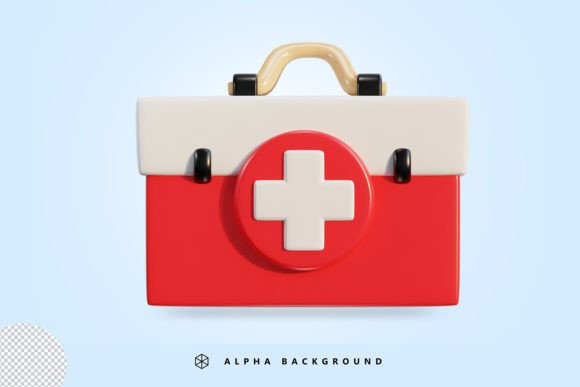
The human brain processes three-dimensional objects differently than flat illustrations. A First aid kit, ambulance emergency box, medical help suitcase Healthcare, emergency concept 3d vector mimics the physical reality of the objects we encounter in daily life. When a person sees a realistic rendering of a red cross on a white case with tangible depth and lighting, their cognitive load is reduced. They do not have to interpret abstract lines; they recognize the object immediately. This instant recognition is crucial in high-stress situations where seconds count.
Furthermore, the aesthetic quality of your visuals reflects the quality of your service or product. If a hospital app uses pixelated or outdated icons, users may subconsciously question the reliability of the information provided. Conversely, a sleek, high-resolution 3D icon suggests modernity and competence. By integrating a professional-grade asset into your projects, you elevate the perceived value of your entire platform. This is particularly important for businesses in the healthcare sector, where trust is the primary currency.
Practical Applications Across Industries
The versatility of a First Aid Kit, Emergency Box 3d Icon extends far beyond simple decoration. Its application varies significantly depending on the user's specific goals and the context in which it is deployed.
- Digital Product Design: For UX/UI designers working on telehealth apps or emergency response platforms, this icon serves as a clear call-to-action button. The depth of the 3D render makes it clickable and inviting, encouraging users to seek help when needed.
- Corporate Safety Training: Safety managers can use these high-resolution images in presentations and manuals to clearly identify equipment locations. The realism helps employees mentally map the location of physical first aid kits in their workplace.
- E-Commerce and Marketing: Online retailers selling medical supplies can use these icons to categorize products effectively. A 3D icon stands out on a product page, drawing the eye to essential items like bandages, antiseptics, and emergency kits.
- Public Signage and Wayfinding: While often printed in 2D, starting with a 3D source file allows for superior shading and perspective adjustments, making printed signs more visible from a distance or at odd angles.
Tailoring the Asset to Your Needs
One size rarely fits all in professional design. Different projects require different adjustments to lighting, color saturation, or background integration. This is why accessing the source files is critical. When you acquire a premium package containing PSD, PNG, and EPS files, you gain full control over the final output.
The PSD (Photoshop Document) file is ideal for designers who need to manipulate layers, adjust shadows, or composite the icon into complex scenes. You can change the color of the cross to match a specific brand palette or alter the lighting to match the environment of your website. The PNG format, especially at a high resolution of 2000×2000 pixels, ensures that the icon remains crisp on retina displays and large print formats without any background clutter. Finally, the EPS (Encapsulated PostScript) vector file allows for infinite scalability. Whether you are printing a massive billboard or a tiny favicon, the image will never lose its sharpness.
Overcoming Common Design Challenges
Many creators struggle with finding assets that are both legally safe to use and technically robust. Free stock images often come with restrictive licenses or hidden watermarks that ruin the professional look of a project. Additionally, low-resolution downloads become pixelated when resized, forcing a redesign. By investing in a fully customizable premium icon set, you eliminate these risks. You ensure that your project is built on a foundation of high-quality assets that can evolve with your needs.
Another common hurdle is consistency. If your project involves multiple icons (e.g., an ambulance, a stethoscope, and a first aid kit), they need to share the same lighting style and perspective. Using a dedicated 3D icon from a cohesive collection ensures that your visual language remains uniform, reinforcing brand identity and improving user experience.
Implementation Strategies for Maximum Impact
To get the most out of your First Aid Kit, Emergency Box 3d Icon, consider the context in which it will be viewed. For digital interfaces, ensure there is sufficient contrast between the icon and the background. The 3D lighting effects should enhance visibility, not obscure the symbol. For print materials, utilize the EPS file to maintain edge sharpness, particularly if the icon is placed near text.
It is also worth considering the psychological impact of color. While the traditional red and white scheme is universally recognized for first aid, slight adjustments in hue can evoke different emotions. A brighter red may signal urgent action, while a softer tone might be more appropriate for a wellness blog. The ability to customize these elements via the provided PSD files allows you to fine-tune the emotional resonance of your imagery.
Conclusion: Investing in Clarity and Safety
Ultimately, the choice of visual assets is a strategic decision that impacts how your audience perceives and interacts with your content. The First Aid Kit, Emergency Box 3d Icon is more than just a graphic; it is a tool for effective communication and safety assurance. By choosing a high-resolution, fully customizable 3D vector, you equip yourself with the flexibility to adapt to various mediums while maintaining a standard of excellence.
Whether you are building the next generation of health tech software or updating your office safety protocols, the clarity provided by professional 3D imagery is unmatched. It bridges the gap between concept and reality, ensuring that when people see the icon, they know exactly where to turn for help. With the inclusion of PSD, PNG, and EPS files, you are not just downloading an image; you are acquiring a versatile asset ready to meet the diverse demands of modern design and safety communication.